Your transaction monitoring system is 95% false positive.
Your investigators know this. Sentinel is the reasoning layer that fixes it — AI-assisted AML alert triage with cited evidence and a complete audit trail, designed to sit on top of Actimize, SAS, Verafin, Oracle FCCM or any internal monitoring system.
40–60%
Alert volume auto-cleared
4–12s
Per-alert analysis
100%
Audit-traceable
$1B–$50B
AUM sweet spot
The hidden cost
Four of five investigation steps are assembly, not judgment.
Per alert · L1 investigator
15–45 min
- Pull 90 days of transaction history
- Check prior alerts on the customer
- Compare behavior to peer baselines
- Review KYC + related-party data
- Write the disposition rationale ← the part that needed a human all along
Per alert · with Sentinel
4–12 sec
Context is assembled by Sentinel. A two-pass Claude analysis returns a structured disposition with cited evidence. The investigator reviews a prepared case, not a triage screen.
Easy cases auto-clear with cited rationales. Ambiguous cases arrive with specific questions for the investigator to answer. Hard cases keep the human firmly in the loop — with the evidence already in front of them.
What this is worth
The math at three different scales.
Conservative assumptions: 30 minutes average L1 handle time, 50% FP-rate reduction (the midpoint of the 40–60% range), $85,000 fully-loaded L1 analyst salary (USD).
$1B–$3B
Small bank
12,000 alerts/year
Alerts auto-cleared
6,000
Hours saved
3,000
FTE equivalent
1.6
Annual loaded-cost recovered
$134,211
$5B–$20B
Mid-size bank
30,000 alerts/year
Alerts auto-cleared
15,000
Hours saved
7,500
FTE equivalent
3.9
Annual loaded-cost recovered
$335,526
$20B–$50B
Neobank / Tier-2
80,000 alerts/year
Alerts auto-cleared
40,000
Hours saved
20,000
FTE equivalent
10.5
Annual loaded-cost recovered
$894,737
Three modules · same architecture
One reasoning pattern, three AML queues.
Triage
Behavioral analysis of TM alerts.
Pulls 90 days of transaction history, peer baselines, prior alerts and KYC. Runs a two-pass Claude analysis. Returns a structured disposition (clear · clear with note · escalate to L2 · escalate to SAR · request info) with cited evidence.
Watchlist
Fuzzy sanctions + PEP adjudication.
Identity match plus jurisdictional analysis on fuzzy hits. Hybrid model split (Haiku 4.5 first pass, Sonnet 4.5 critique) keeps cost low while preserving rigor on the calls that matter.
SAR
FinCEN Form 111 narrative drafting.
Consumes the upstream Triage analysis and produces a 7-section narrative (5 W's + how + actions). Every section carries citations; every citation traces back to a specific transaction ID, KYC field or prior alert.
The product in hand
Three cases from the demo sandbox.
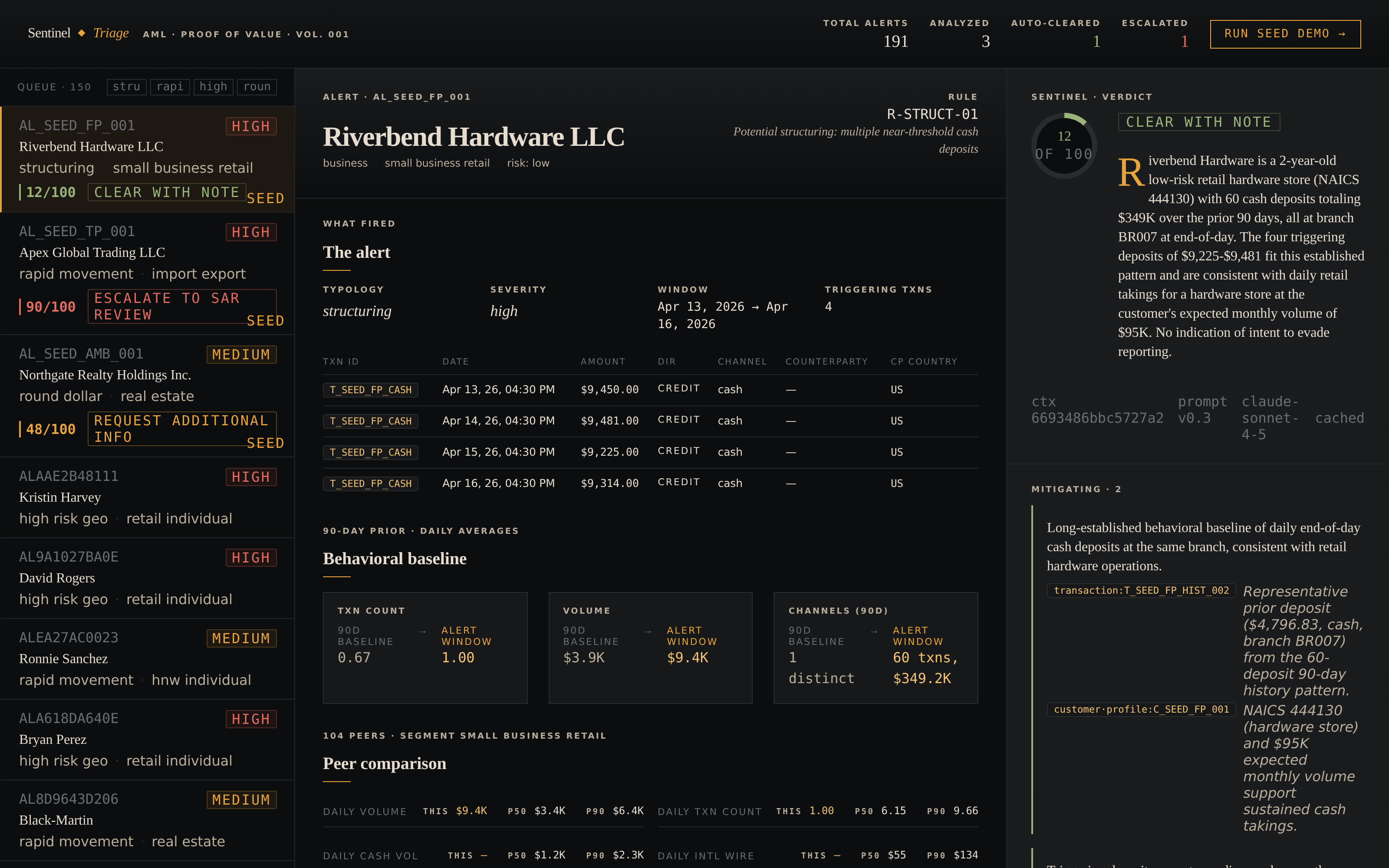
Obvious false positive
Riverbend Hardware · score 12/100 · auto-clear
Structuring rule fires on a small-business owner with 24 months of consistent cash-deposit history. Sentinel clears it in 4 seconds, cited.
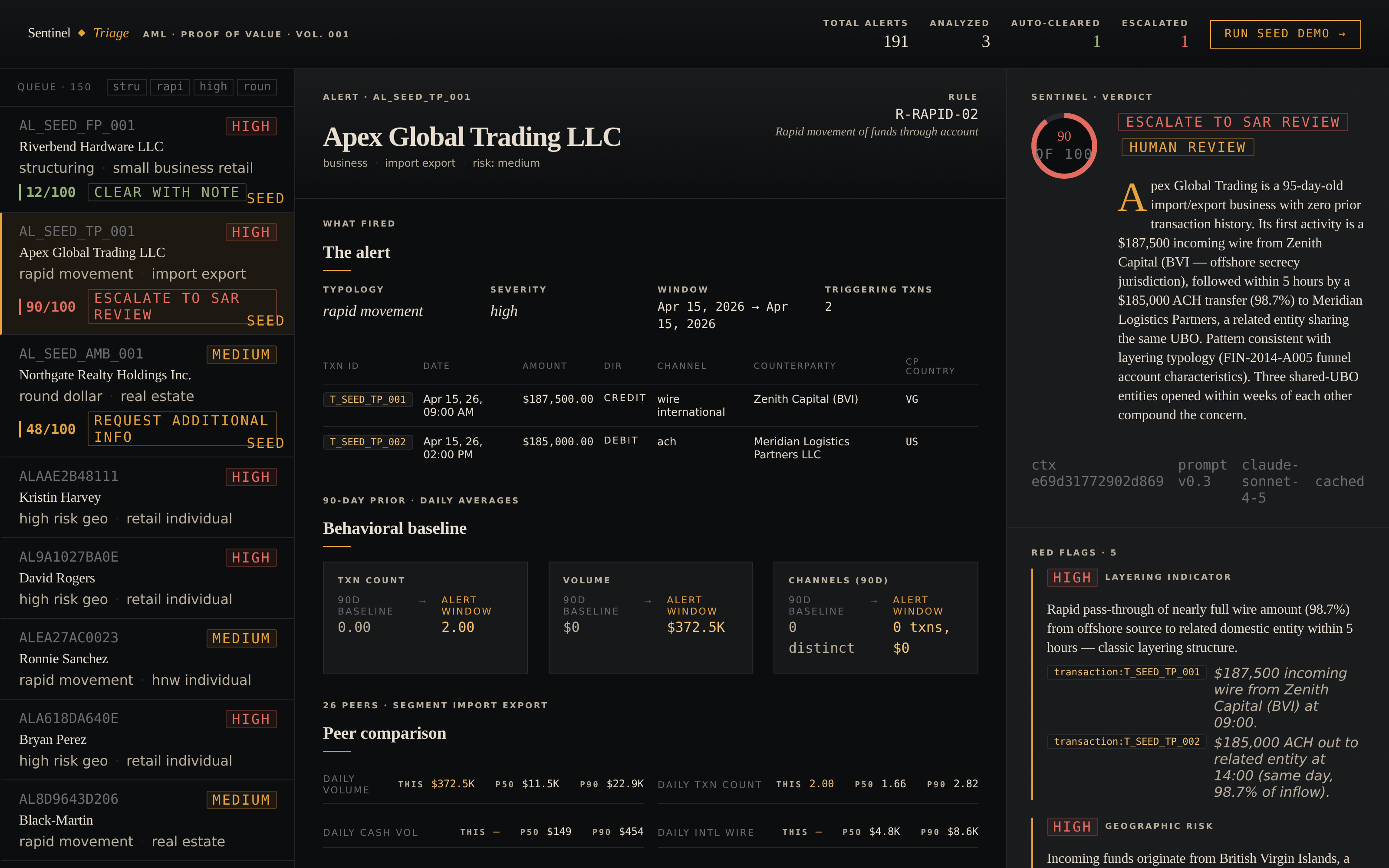
Genuine layering pattern
Apex Global Trading · score 90/100 · escalate to SAR
$187,500 BVI wire in, $185,000 to related entity five hours later, shared UBO. Cited evidence chain plus FinCEN advisory reference, ~12 seconds.
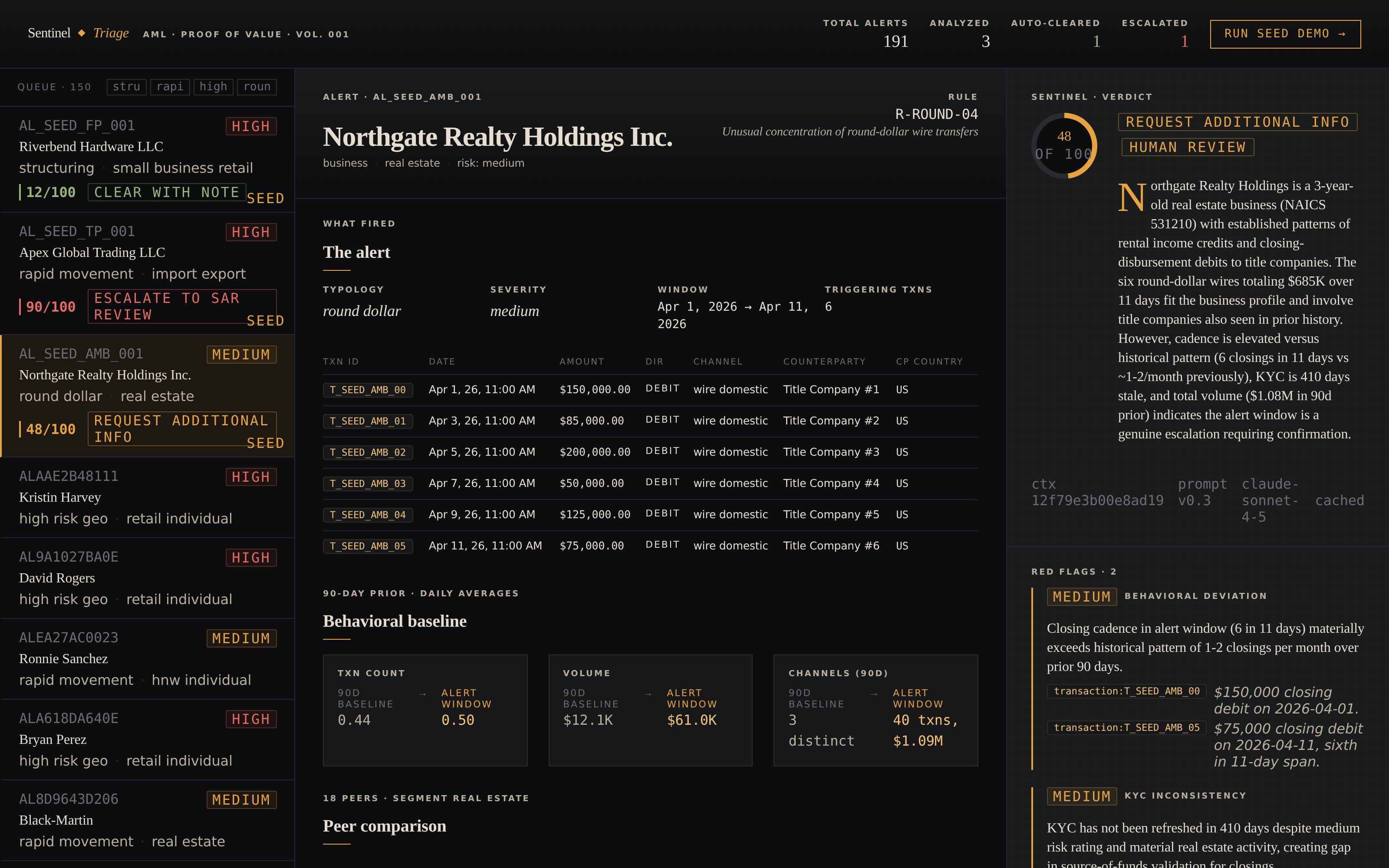
Genuinely ambiguous
Northgate Realty · score 48/100 · human review
Round-dollar wire activity that could be legitimate real-estate closings — or layering. Sentinel flags it with specific questions for the investigator.
How it's built
Architecture: one pattern, end-to-end traceable.
Your existing TM system
Actimize · SAS · Verafin · Oracle FCCM · internal
Context assembler
90-day txns · prior alerts · KYC · peer baselines
Two-pass Claude reasoning
Analyzer (Sonnet) → Critique (Sonnet) · Pydantic-validated JSON
Structured disposition + cited evidence
Clear · clear-w-note · escalate-L2 · escalate-SAR · request-info
Investigator UI · prepared case
React queue · red flags · cited evidence · recommended action
Audit log — every decision reproducible
Prompt v · model v · context hash · raw passes · human disposition
Data layer
DuckDB · single-file, embedded analytics
Backend
Python 3.11+ · FastAPI · Pydantic-validated schemas
Reasoning
Anthropic SDK · Sonnet + Haiku · two-pass + critique
Frontend
React + Vite · Tailwind · shadcn/ui
Audit
Per-analysis JSON · content hash · prompt + model version
Deploy
Runs in your environment · no SaaS data flows
Non-negotiables
- Every rationale cites specific transaction IDs or customer data points. No vague reasoning.
- Structured output only. Every Claude call returns Pydantic-validated JSON.
- Two-pass reasoning. Analysis + critique, both logged.
- Complete audit trail per decision. Reconstructable months later.
- No real PII, ever. Synthetic-only for the demo. Your data, your environment for paid engagements.
- Sits on top of your existing TM system. We sync, never replace.
How it lands
Two-week proof-of-value. Fixed fee.
We run on your sanitized or synthetic data. Up to 5 typologies. Up to 10,000 historical alerts. Onsite walkthrough for your FinCrime and compliance leadership at the end. Model-risk documentation sized for your second line.
Discovery + data ingest
Sanitized or synthetic data from your environment. Map your typologies and risk appetite. Stand up the sandbox with your alert schema.
Prompt + reasoning tuning
Calibrate the analyzer prompts to your alert taxonomy. Hand-grade 30 alerts per typology to confirm rationale quality before scaling.
Audit trail + model-risk docs
Wire the full audit log: prompt version, model version, content hash, raw passes, human disposition. Produce model risk documentation for your MRM team.
Onsite walkthrough
Demo to your FinCrime + compliance leadership on your data. Executive summary sized for the board packet, MRM docs sized for your second line.
You leave with
- · Working sandbox in your environment
- · Prompt library tuned to your typologies
- · Full audit-trail documentation
- · Board-packet-sized executive summary
Runs on your stack
- · DuckDB or your existing data warehouse
- · Python + FastAPI, deployed in your VPC
- · Anthropic API or AWS Bedrock (Claude)
- · No SaaS data egress required
Who it's for
- · Mid-size banks ($1B–$50B AUM)
- · Neobanks + fintechs scaling AML
- · Enforcement-prep / exit remediation
- · FIUs evaluating incumbent tuning
Next step
Sit with us for thirty minutes.
We'll walk you through the three demo cases on live data, answer model-risk questions, and come back inside one week with a proof-of-value scope sized for your taxonomy. Two-week engagement, fixed fee, no production-system risk.
SEYSO Services Inc. · Toronto, ON · info@seysoservices.com